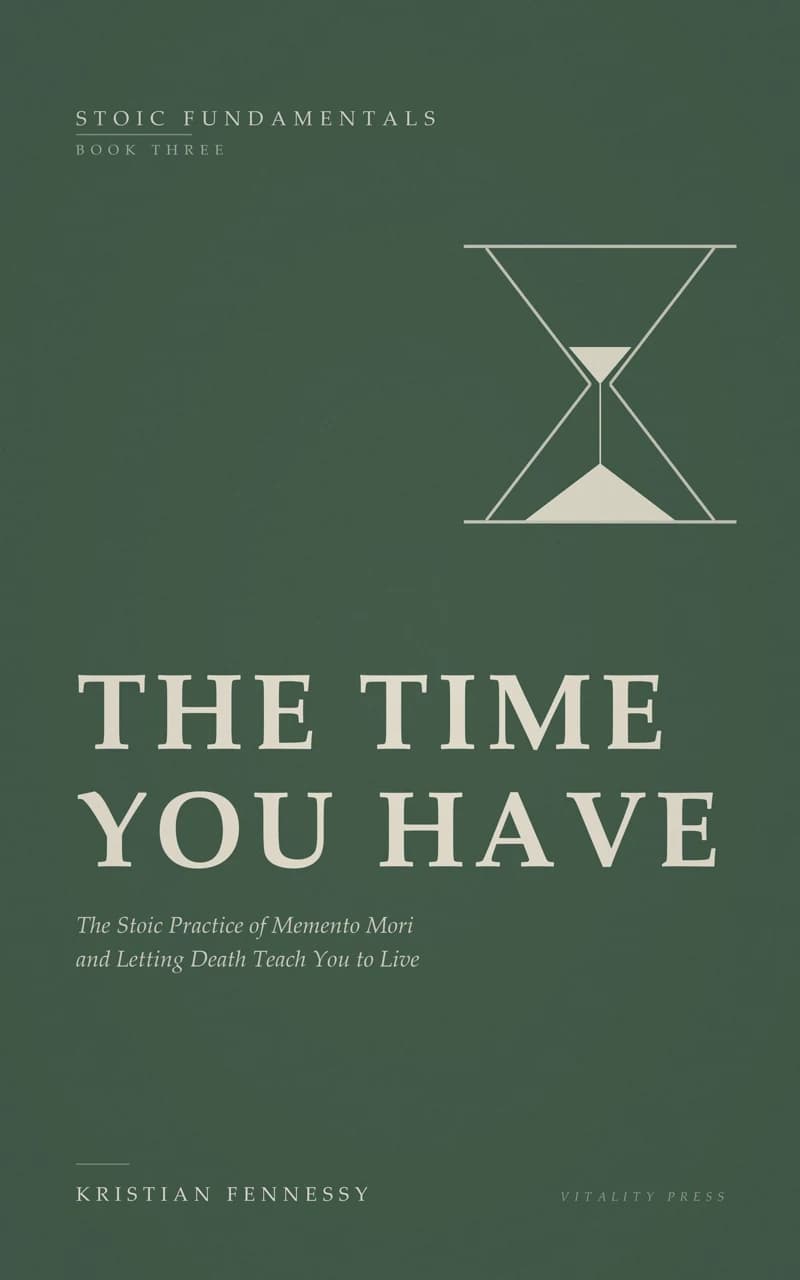
Book Three · Memento mori · Out now
The Time You Have
The Stoic Practice of Memento Mori and Letting Death Teach You to Live
Memento mori — “remember you will die” — and feel more alive for it.
Kindle · $4.99 — The Time You Have on AmazonPaperback · $12.99 — The Time You Have on AmazonHardcover · $21.99 — The Time You Have on Amazon
On Amazon · Free to read on Kindle Unlimited
You have seen the words — memento mori, remember you will die — on a coin, a skull, a tattoo. And you probably flinched, because it sounds morbid. Who wants to spend their one life dwelling on the end of it?
That instinct is what this book takes on first. Remembering death is not morbid. It is not nihilism, it is not hedonism, and it is not a life of dread. The Stoics kept death daily before their eyes for the opposite reason: the fact of the ending is what makes the time count.
The dying do not waste their afternoons. Neither, it turns out, do the people who remember they are dying.
Get The Time You Have on Amazon
Kindle · $4.99 — The Time You Have on AmazonPaperback · $12.99 — The Time You Have on AmazonHardcover · $21.99 — The Time You Have on Amazon
On Amazon · Free to read on Kindle Unlimited
Let death and exile, and all other things which appear terrible be daily before your eyes, but chiefly death, and you will never entertain any abject thought, nor too eagerly covet anything.
Inside, in three parts
- Part One
The Idea
What memento mori actually is, the four things it is not, the insight that time — not lifespan — is the true scarcity, and the working tool of the view from the end.
- Part Two
The Hard Cases
The idea tested where it hurts: busyness, the deferred life, trivial worry cut down to size, the hunger to be remembered, growing older, the raw fear of death, and the death that comes too soon — never called good.
- Part Three
Living It
The practices that turn insight into a way of living: returning to the only moment you have, attending to the finite and numbered, and the deliberate rehearsal of death.
What you will take away
- Why “remember you will die” is the most clarifying thought available — and the four misreadings that keep people from using it.
- The Stoic insight that flips the problem: life is not short, we waste most of it.
- How to borrow the view from the end on purpose, instead of stumbling into it after a scare.
- How finitude shrinks the falsely large — the replayed slight, the status sting, the wish to be remembered.
- What to do with the fear of death itself, rather than around it.
- Where the practice reaches its limit: the death that comes too soon.
Pick it up if
Anyone who keeps encountering memento mori and suspects it is either morbid or a slogan — often arriving through a milestone birthday, a death in the wider circle, or a sense that the years are accelerating.
Skip it if
Readers wanting a broad survey, a grief or bereavement book (this is about your own finitude, not consolation for loss), or a morbid meditation on dying — this one lightens rather than darkens.
Key facts
- The Time You Have: The Stoic Practice of Memento Mori and Letting Death Teach You to Live is Book 3 of the Stoic Fundamentals series, published by Vitality Press.
- The Time You Have covers one Stoic idea at full depth: memento mori, “remember you will die”: the Stoic practice of keeping your own death in view so that you stop postponing your life and spend the time you have on what matters.
- The Time You Have is available on Amazon as a Kindle ebook, a paperback, and a hardcover.
- The Kindle edition costs $4.99 and is free to read with a Kindle Unlimited subscription; the ebook is sold only on Amazon.
- The paperback costs $12.99 (ISBN 9798178161425).
- The hardcover costs $21.99 (ISBN 9798178162668).
- The Time You Have has 16 chapters in three parts, and 130 pages in print.
- The Time You Have was published on October 2, 2026.
Reading order
The Time You Have is Book 3 of three. Every book stands alone, so you can start here. If you want the order, it runs control, then acceptance, then mortality: In Your Control, Love What Happens, then The Time You Have.
- Book 1: In Your Control — the dichotomy of control
- Book 2: Love What Happens — amor fati
- Which one should you read first?
Questions about The Time You Have
- What is The Time You Have about?
- The Time You Have is a whole book on memento mori, the Stoic practice of remembering that you will die. It shows why keeping death in view clarifies rather than darkens, tests the idea against busyness, the deferred life, growing older, and the fear of death itself, and turns it into daily practice.
- Is The Time You Have morbid?
- No. The book's argument is that remembering death is the opposite of morbid: it shrinks the trivial back to its real size and ends the postponement of the life you mean to live. It lightens rather than darkens.
- Is The Time You Have a grief book?
- No. It is about your own finitude, not consolation for a loss. Readers looking for a bereavement book should know that before they buy.
- Is The Time You Have on Kindle Unlimited?
- Yes. The Kindle edition is in Kindle Unlimited. Otherwise it is $4.99 on Kindle, $12.99 in paperback, and $21.99 in hardcover, all on Amazon. The print edition runs 130 pages.
Read the idea first, free
The whole of memento mori is explained on this site — including the misreadings and the place it reaches its limit. If the explainer is useful, the book is the same thing at depth.